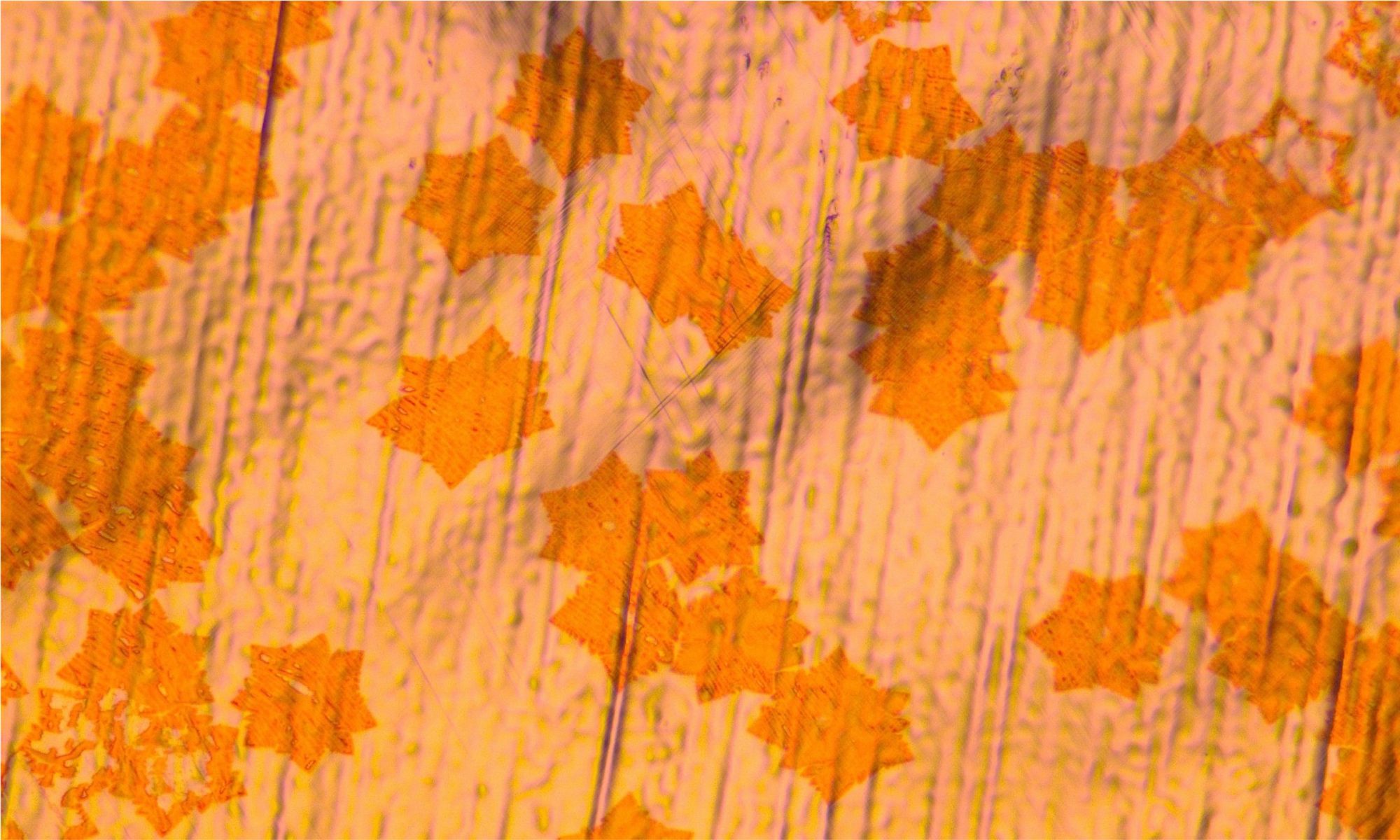
On September 22, 2026, the Aachen Graphene & 2D Materials Center welcomed a delegation of researchers from Japan for a one-day networking workshop at RWTH Aachen University. The meeting brought together scientists working across a broad range of topics in graphene and two-dimensional materials, from materials growth and characterization to quantum phenomena, photonics and electronic devices.
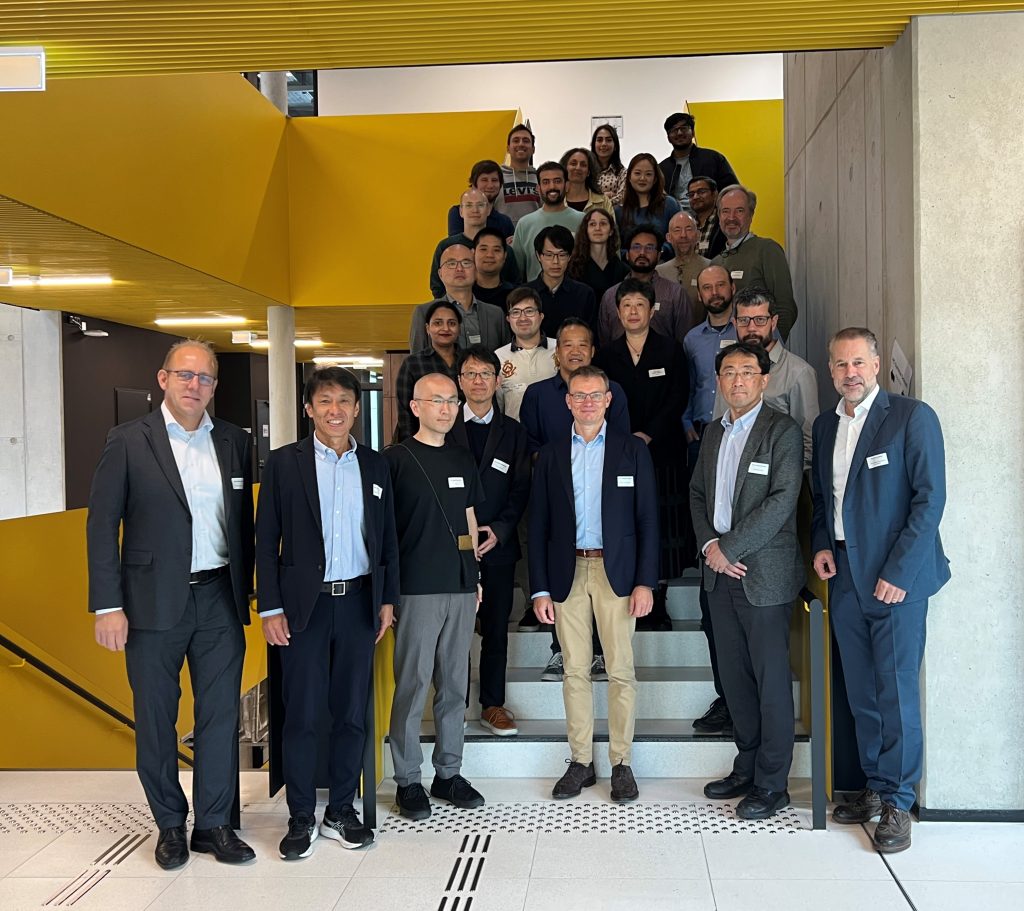
The workshop was a friendly and productive opportunity to exchange ideas, discuss recent developments and explore common interests. Short scientific presentations were complemented by lively discussions and laboratory visits, providing plenty of opportunity for more detailed conversations beyond the individual talks.
The workshop opened with a welcome address by Prof. Sven Ingebrandt (RWTH), Rector’s Delegate for Collaboration with Japan at RWTH Aachen University. He provided an overview of existing collaborations between RWTH and Japanese institutions, as well as exchange programmes supporting the mobility of students and researchers.
Prof. Max Lemme (RWTH & AMO GmbH) then introduced the Aachen Graphene & 2D Materials Center and presented selected research activities in Aachen. His presentation included work from the group of Prof. Andrei Vescan, who unfortunately could not attend the workshop, as well as recent research on 2D materials at the Chair of Electronic Devices (ELD) and AMO GmbH, including work on MEMS sensors and memristive devices.
Prof. Kazunari Matsuda (Kyoto University) presented a robotic exfoliation and stacking system developed in his laboratory, illustrating approaches towards increasingly automated assembly of 2D materials. He also discussed his research on quantum-light applications of 2D heterostructures, with a particular focus on moiré excitons.
Prof. Thomas Taubner (RWTH) presented the potential of scattering-type scanning near-field optical microscopy (s-SNOM) for distinguishing domain boundaries and different stacking orders in multilayer graphene. He also discussed research in his group on polaritons and the engineering of polaritonic systems.
Prof. Hiroki Ago (Kyushu University) introduced the initiative Science of 2.5 Dimensional Materials, which brings together research perspectives on materials whose properties are governed not only by their individual layers but also by their interfaces and stacking. He also presented recent developments in the growth and transfer of graphene, hBN and transition-metal dichalcogenides (TMDs). Particularly interesting were results obtained using a UV-transfer tape, which offers a promising approach for the transfer and integration of 2D materials.
Prof. Christoph Stampfer (RWTH) presented research on quantum dots in bilayer graphene and introduced a tool developed in his group for automated flake search, illustrating the increasing role of automation in the handling and investigation of 2D materials
Prof. Tomoki Machida (University of Tokyo) discussed recent results on twisted van der Waals heterostructures, including moiré–moiré reconstruction and the possibility of engineering intrinsic one-dimensional moiré superlattices. These structures offer an intriguing platform for exploring one-dimensional physics.
Prof. Yukiko Yamada-Takamura (JAIST) gave an introduction to Xenes, or transgraphenes, and presented her work on understanding and stabilizing these elemental two-dimensional structures.
Dr. Zhenxing Wang (AMO GmbH) provided an overview of the activities of AMO and, in particular, of the Graphene Electronics group, including recent work carried out within projects such as Attoswitch, 2D-PL and Greenergy.
Prof. Yasumitsu Miyata (NIMS) presented recent results on the chemical vapour deposition (CVD) growth of high-quality TMDs . His presentation highlighted the role of point defects and approaches for characterizing them using conductive atomic force microscopy, followed by a discussion of the effects of vanadium doping.
The scientific programme was followed by laboratory tours, providing an opportunity to continue the discussions in a more hands-on setting. The delegation visited the cleanroom facilities at AMO GmbH, as well as the laboratories of Christoph Stampfer and Thomas Taubner at RWTH Aachen University.
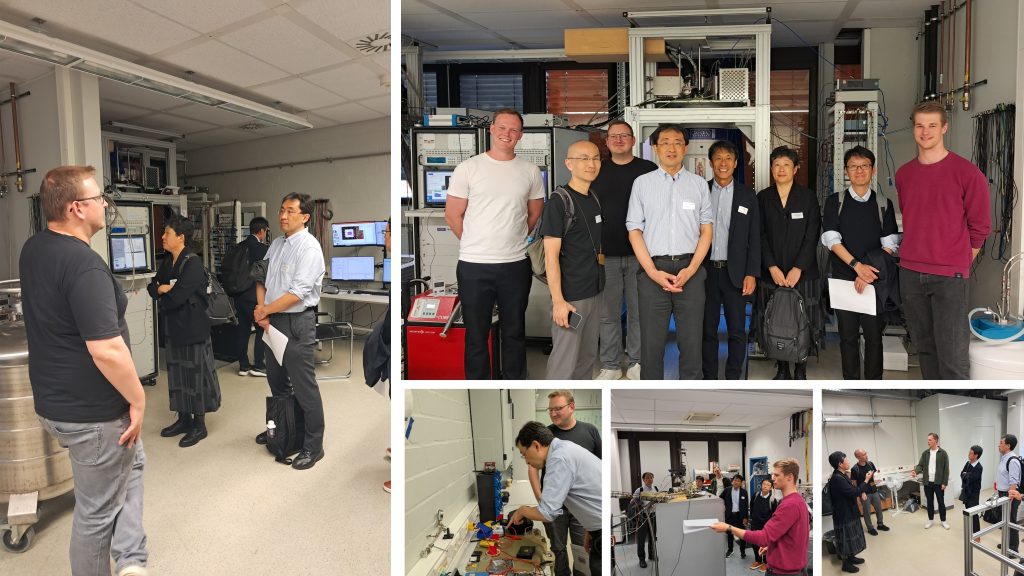
The Aachen Graphene & 2D Materials Center is grateful to all participants for the open and engaging discussions. The visit highlighted the strong complementarity between research activities in Aachen and Japan and provided an excellent basis for developing future collaborations in graphene and 2D materials.