2nd Workshop on “2D Materials for Future Electronics”

The 2nd Workshop on “2D Materials for Future Electronics” will take place on March 3–4, 2026, in Aachen, Germany, bringing together leading researchers and industry experts for a two-day, in-person exchange on recent advances and future perspectives of two-dimensional materials in electronic applications.

This year, the workshop will focus in particular on the role of 2D materials in enabling energy-efficient electronics, addressing novel device concepts, materials integration strategies, and emerging technologies. Through invited talks and interactive discussions, participants will gain valuable insights into current research trends as well as the key scientific and technological challenges shaping the next generation of electronic systems.

Organized jointly by AMO GmbH, the Aachen Graphene & 2D Materials Center, and RWTH Aachen University, the workshop continues a successful series of events dedicated to fostering exchange within the 2D materials community.

Participation is free and open to everybody.

For more information and registration, please visit the following page: https://www.amo.de/de/events/2nd-workshop-on-2d-materials-for-future-electronics/


The workshop is financially supported by the European Union via the projects 2D-ADDICT, 2D-PL, CERBERUS, and ENERGIZE, as well as by the Deutsche Forschungsgemeinschaft (DFG, German Research Foundation), via the Collaborative Research Center/Transregio TRR404 „Next Generation Electronics With Active Devices in Three Dimensions [Active-3D]“, and by the the BMFTR through the Cluster4Future NeuroSys and the project MoS2FET (grant number 01DK24018, part of the „Förderung von Projekten zum Thema Forschungs- und Entwicklungszusammenarbeit zwischen Deutschland und der Ukraine”). A sponsorhip by Oxford Instruments Plasma Technology is also acknowledged.

Exploring Quantum Geometry with Terahertz Light: A Breakthrough in Twisted Bilayer Graphene

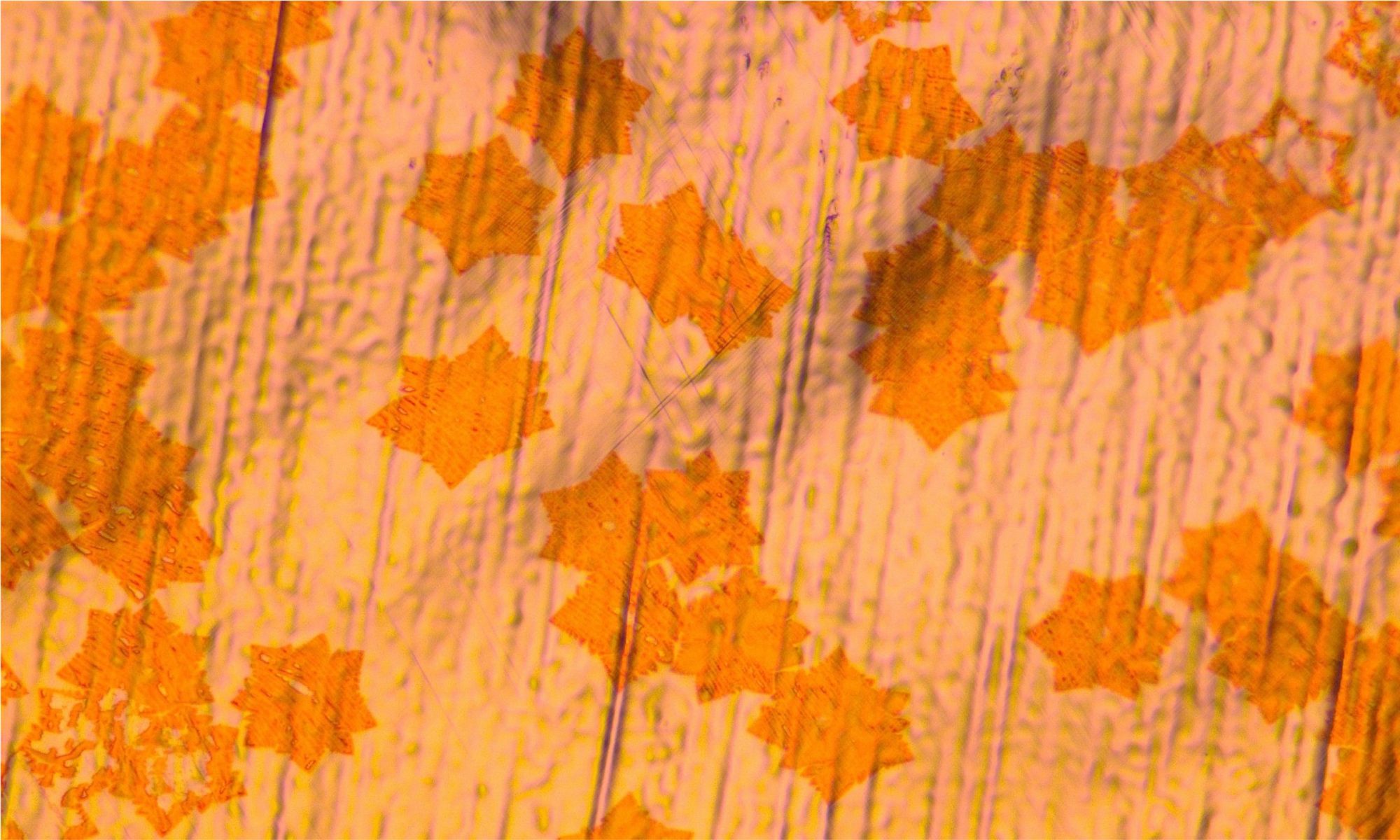
A recent groundbreaking study led by ICFO researchers, in collaboration with several international research groups including memebrs of the Aachen Graphene & 2D Materials Center, has uncovered previously unseen behaviors in magic-angle twisted bilayer graphene using terahertz light. As part of this international effort, the research sheds new light on the quantum geometry of this enigmatic material, revealing how the electronic wavefunctions of electrons are shaped by their environment.

Continue reading “Exploring Quantum Geometry with Terahertz Light: A Breakthrough in Twisted Bilayer Graphene”

A scalable method to reduce the contact resistance of graphene

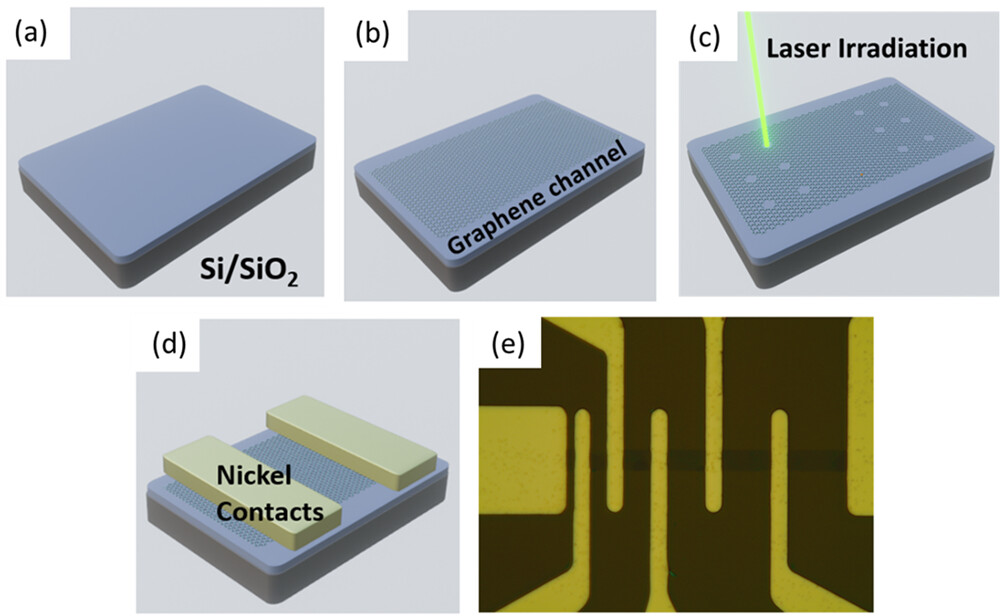
The exceptional electronic properties of graphene make it a material with large potential for low-power, high-frequency electronics. However, the performance of a graphene-based device depends not only on the properties of the graphene itself, but also on the quality of its metal contacts. The lack of effective and manufacturable approaches to establish good ohmic contacts to a graphene sheet is one of the factors that limit today the full application potential of graphene technology.

(a–d) Schematics showing the process sequence for manufacturing the devices and the laser irradiation of graphene in the contact regions. (e) Optical micrograph of one of the measured devices
Continue reading “A scalable method to reduce the contact resistance of graphene”

A non-destructive way to probe inter-layer coupling on millimeter-scale graphene-MoS2 heterostructures

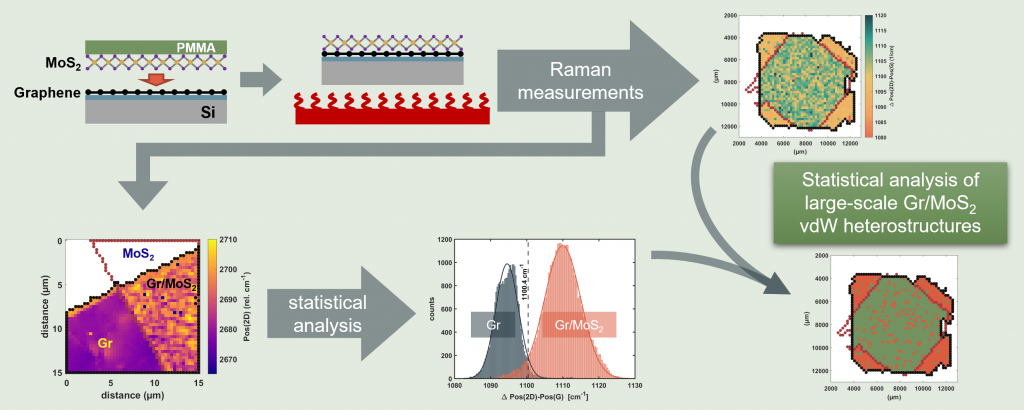
One of the great assets of two-dimensional (2D) materials is the possibility of placing different materials on top of each other to form heterostructures with properties tailored to specific application scenarios. However, the quality of the final material stack strongly depends on the electronic coupling between the different materials. Measuring this coupling in a non-destructive way is therefore an important aspect for material development. Researchers from AMO GmbH, RWTH Aachen University and AIXTRON SE have now established a methodology based on Raman spectroscopy for estimating quantitatively the coupling between graphene and molybdenum disulfide (MoS2) in heterostructures up to the mm2-scale.

Graphical summary of the work of Nico Rademacher and co-workers (From: Micro and nano Engineering, https://doi.org/10.1016/j.mne.2024.100256)
Continue reading “A non-destructive way to probe inter-layer coupling on millimeter-scale graphene-MoS2 heterostructures”